


AI, Data and Cybersecurity: Building the Foundation for the Next Technology Wave
For years, enterprise technology strategies were built around digital transformation. Organizations invested in cloud migration, automation, collaboration platforms, and new digital services in an effort to modernize operations and improve competitiveness. Today, a new technology wave is emerging.
Artificial intelligence is rapidly moving from experimentation to practical deployment. Data has become one of the most valuable corporate assets. Cybersecurity has evolved from a support function into a board-level priority. Together, these three areas are redefining how organizations think about technology investments.
According to Global CIO’s latest research, technology leaders increasingly view AI, data management, and cybersecurity not as separate initiatives but as interconnected components of a single strategic foundation. Organizations that successfully combine these capabilities will be better positioned to compete in the coming decade.
The AI Conversation Has Changed
Just two years ago, many discussions about artificial intelligence were dominated by excitement and speculation. Organizations were exploring proof-of-concept projects, testing new tools, and trying to understand how emerging technologies might affect their businesses. Today, the conversation is far more practical.
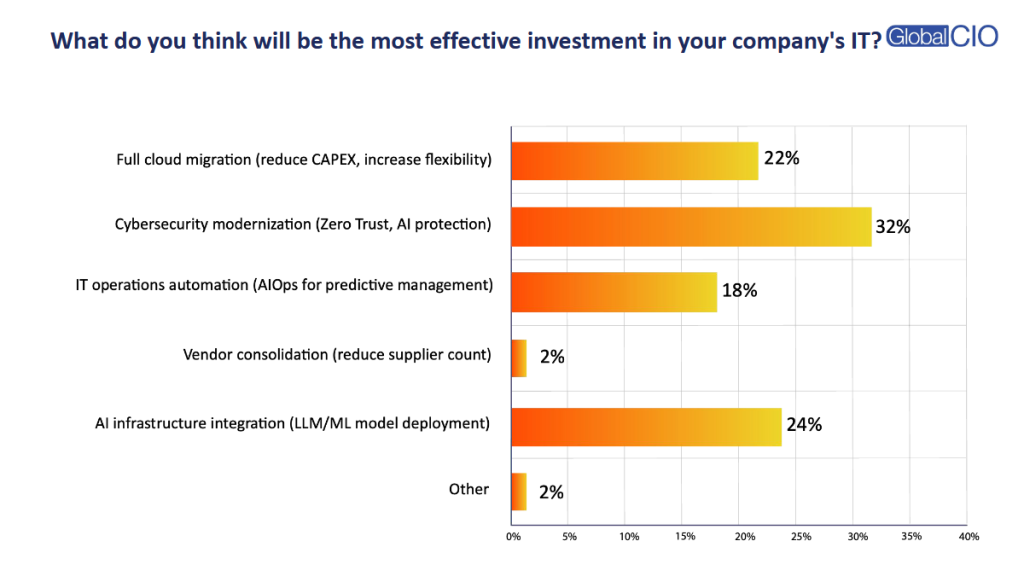
Technology leaders are no longer asking whether AI matters. Instead, they are asking how to deploy it effectively, securely, and at scale. This shift is reflected in investment priorities. Many CIOs now view AI infrastructure, machine learning capabilities, and large language model deployment as strategic initiatives rather than experimental projects. The reason is simple.
Business leaders increasingly expect AI to improve productivity, accelerate decision-making, enhance customer experiences, and create new opportunities for growth. As expectations rise, organizations are realizing that successful AI adoption requires far more than access to powerful algorithms. It requires a foundation.
Why Data Has Become the Most Important Technology Asset
Artificial intelligence is only as effective as the data that supports it. This reality is driving a renewed focus on data management across industries.
For many organizations, the greatest challenge is not implementing AI tools but creating the conditions that allow those tools to generate reliable outcomes. Poor data quality, fragmented information systems, inconsistent governance practices, and limited visibility can quickly undermine even the most sophisticated AI initiatives. As a result, technology leaders are investing heavily in data platforms, analytics capabilities, governance frameworks, and business intelligence solutions.
The goal is not simply to collect more information. The objective is to create trusted, accessible, and actionable data that can support decision-making across the enterprise. Organizations that achieve this level of maturity gain a significant advantage. They can respond more quickly to market changes, identify operational opportunities earlier, and deploy AI solutions with greater confidence. In many respects, data has become the infrastructure of the AI era.
The New Role of Cybersecurity
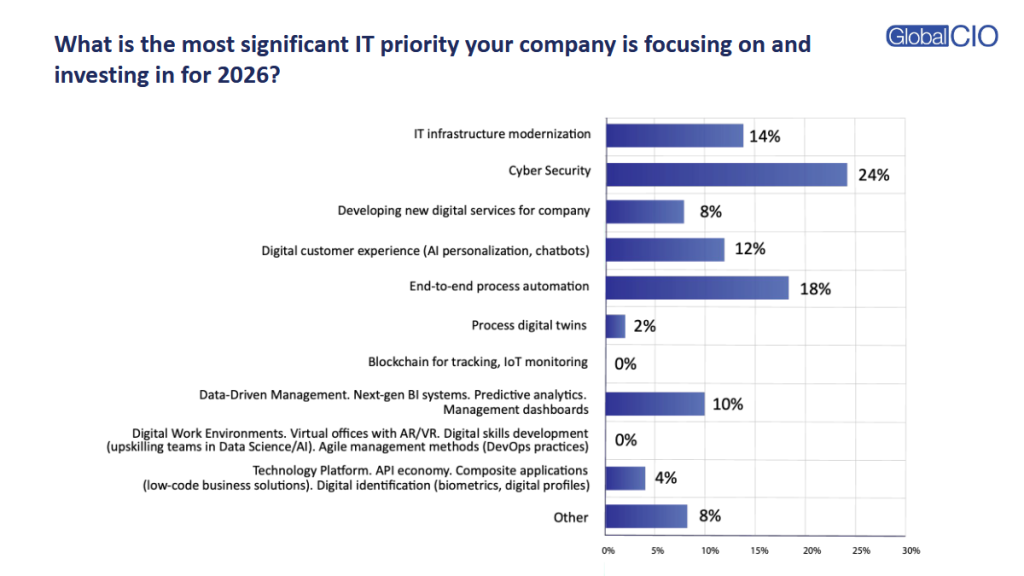
While AI attracts headlines and investment, cybersecurity remains the top concern for many technology leaders. This is hardly surprising. As organizations become more digital, they also become more vulnerable. Cloud environments, remote work models, interconnected ecosystems, third-party integrations, and AI-driven applications all increase complexity and expand the potential attack surface. What makes the current environment different is the growing strategic importance of cybersecurity. Historically, security was often viewed as a technical function responsible for preventing breaches and ensuring compliance.
Today, cybersecurity plays a much broader role. It influences vendor selection, cloud strategy, digital transformation programs, regulatory compliance, customer trust, and even corporate reputation. For many CIOs, security is no longer a defensive capability. It is an enabler of business growth. Organizations that can demonstrate resilience and strong security practices are better positioned to adopt new technologies, enter new markets, and build trust with customers and partners.
AI Creates New Security Challenges
The rise of artificial intelligence introduces an entirely new category of cybersecurity concerns. AI systems depend on vast amounts of data. They interact with critical business processes and increasingly influence operational decisions. This creates new risks that traditional security frameworks were not designed to address.
Organizations must now consider issues such as model security, data integrity, unauthorized access to AI systems, prompt manipulation, and governance of AI-generated outputs. At the same time, attackers are beginning to use AI to increase the sophistication and scale of cyber threats. This creates a technology arms race in which both defenders and adversaries are leveraging artificial intelligence. As a result, many organizations are exploring AI-powered security tools capable of detecting anomalies, identifying threats, and responding to incidents more quickly than traditional approaches. The future of cybersecurity will almost certainly be shaped by AI on both sides of the battlefield.
Building Infrastructure for the Next Decade
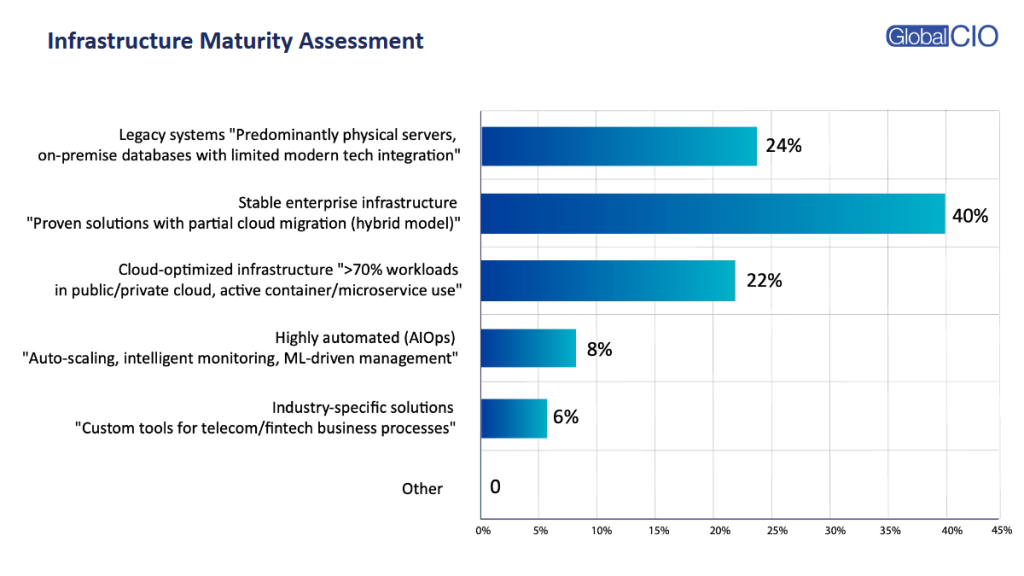
One of the most important findings of the research is the growing recognition that advanced technologies require strong infrastructure. Organizations increasingly understand that AI, analytics, and cybersecurity cannot operate effectively without modern foundations. This includes cloud environments, data architectures, storage platforms, network modernization, and management systems capable of supporting increasingly complex digital operations. The widespread adoption of hybrid and multi-cloud strategies reflects this reality.
Rather than relying on a single technology platform, organizations are creating flexible ecosystems designed to balance performance, resilience, security, and scalability. Infrastructure is no longer viewed as a back-office concern. It has become a strategic asset that directly influences innovation potential.
Why Visibility Matters More Than Automation
The enthusiasm surrounding AI often creates the impression that automation is the ultimate objective. In practice, many technology leaders are focused on something more fundamental: visibility. Before organizations can automate decisions, they need to understand what is happening across their environments. Before AI can optimize operations, companies need accurate data, reliable monitoring, and clear governance. This explains why monitoring platforms, analytics tools, and management systems remain among the most widely adopted technologies. The lesson is straightforward.
Organizations that invest in visibility today will be better positioned to benefit from intelligence tomorrow. Without transparency, automation becomes risky. Without reliable data, AI becomes unreliable. The path to advanced technology adoption begins with operational clarity.
The Emergence of a New Technology Stack
Taken together, these trends point toward the emergence of a new enterprise technology stack. In the past, digital strategies often focused on applications. Today, competitive advantage is increasingly built on three interconnected layers: Cybersecurity provides trust and resilience. Data provides insight and intelligence. Artificial Intelligence provides acceleration and automation. Each layer depends on the others.
AI cannot function effectively without high-quality data. Data cannot be trusted without strong governance and security. Security becomes increasingly difficult without intelligent tools capable of operating at scale. Organizations that treat these areas as separate initiatives risk creating fragmented capabilities and missed opportunities. Those that build integrated strategies will gain a significant advantage.
Preparing for the Next Technology Wave
The next phase of enterprise technology will not be defined by a single breakthrough innovation. Instead, it will be shaped by the convergence of AI, data, and cybersecurity. Technology leaders understand that success will depend less on acquiring the newest tools and more on building the capabilities required to use them effectively. This requires long-term thinking. It means investing in infrastructure before demand becomes urgent. It means strengthening governance before risks emerge. It means building data foundations before launching large-scale AI programs.Most importantly, it means recognizing that technology transformation is no longer about individual projects.
It is about creating an environment where innovation can happen safely, efficiently, and repeatedly. The organizations that succeed in the coming decade will not simply adopt AI. They will build the foundations that allow AI, data, and cybersecurity to work together as a unified engine of growth, resilience, and competitive advantage.