


Five CIO Priorities for 2027: Insights from an International IT Community Survey
Artificial intelligence, limited budgets, growing business expectations, and the need for rapid change — CIOs have to manage all these challenges at the same time. Today, business leaders expect more than reliable IT systems. They want IT to deliver measurable business results.
So, what should CIOs focus on in the coming year?
The Global CIO study IT Leaders' Priorities 2026, conducted in Q3 2026, highlighted key challenges and tensions that CIOs around the world can relate to. It also revealed common approaches to setting priorities.
Here are five key takeaways based on responses from more than 200 CIOs.
1. Measurable Business Value Matters More Than New Technology
Businesses are becoming less interested in adopting technology just for the sake of innovation. The main question for CIOs today is simple: what value will the company get from this investment?
According to the Global CIO study, 30% of respondents said that business process automation had delivered the greatest measurable business impact over the past two years. Another 17% pointed to improvements in customer services, while 11% selected infrastructure modernization.
This is an important finding. Despite the rapid development of AI and other technologies, companies still see the greatest value in solving practical business problems: reducing manual work, speeding up operations, and improving customer service.
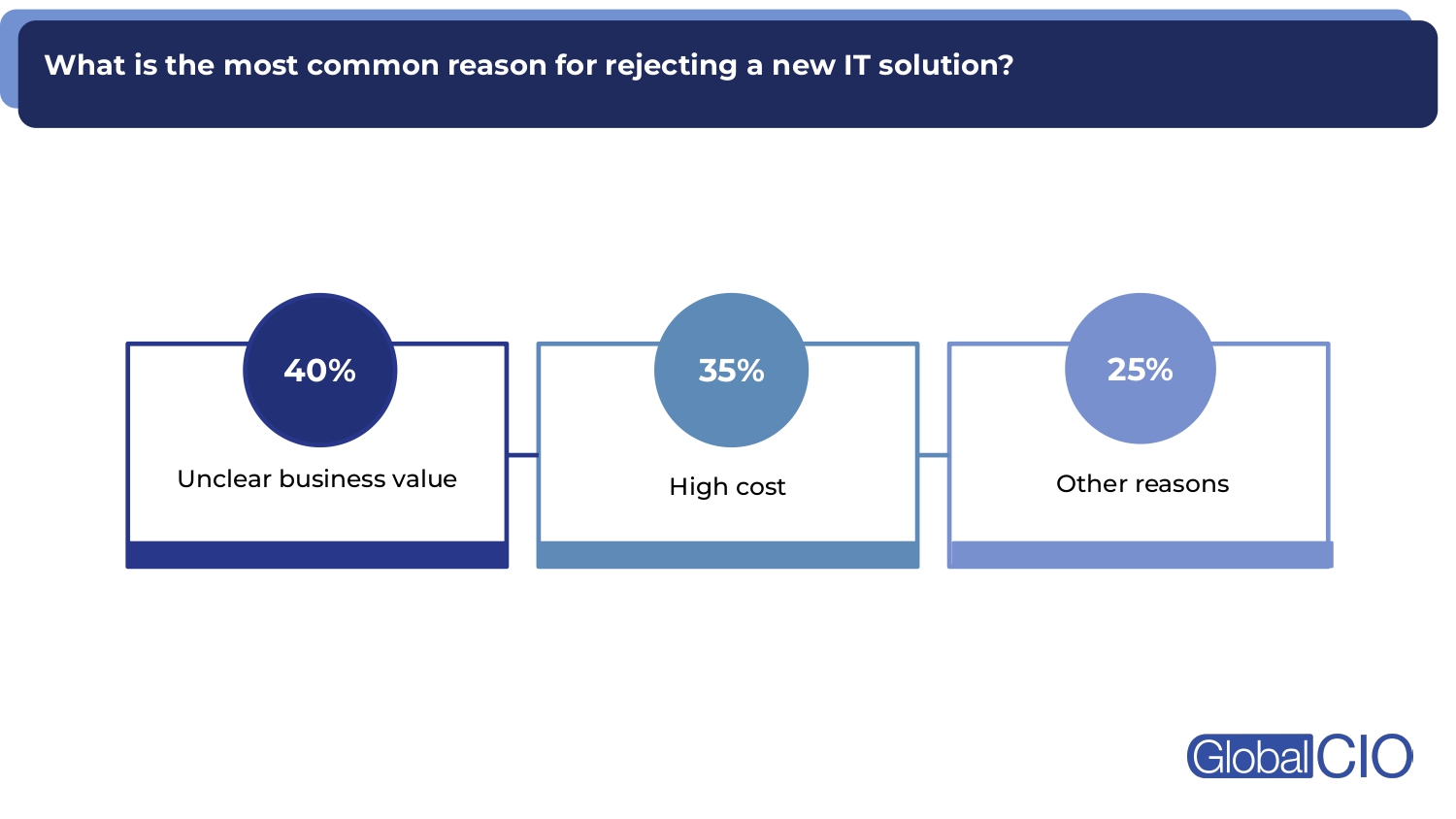
At the same time, unclear business value accounted for 40% of responses about why companies reject new IT solutions, while high costs accounted for 35%. Even a promising technology may fail to get funding if its value is difficult to explain.
For CIOs, this means taking a fresh look at how they manage IT investments. Every major project should answer a few basic questions: What business problem does it solve? How will success be measured? And when can the company expect results?
Cost savings should not be the only measure of success. Revenue growth, faster time to market, higher employee productivity, and better customer experience can be just as important.
The key principle is to start with a business problem, not with a technology.
2. Moving from AI Pilots to Results at Scale
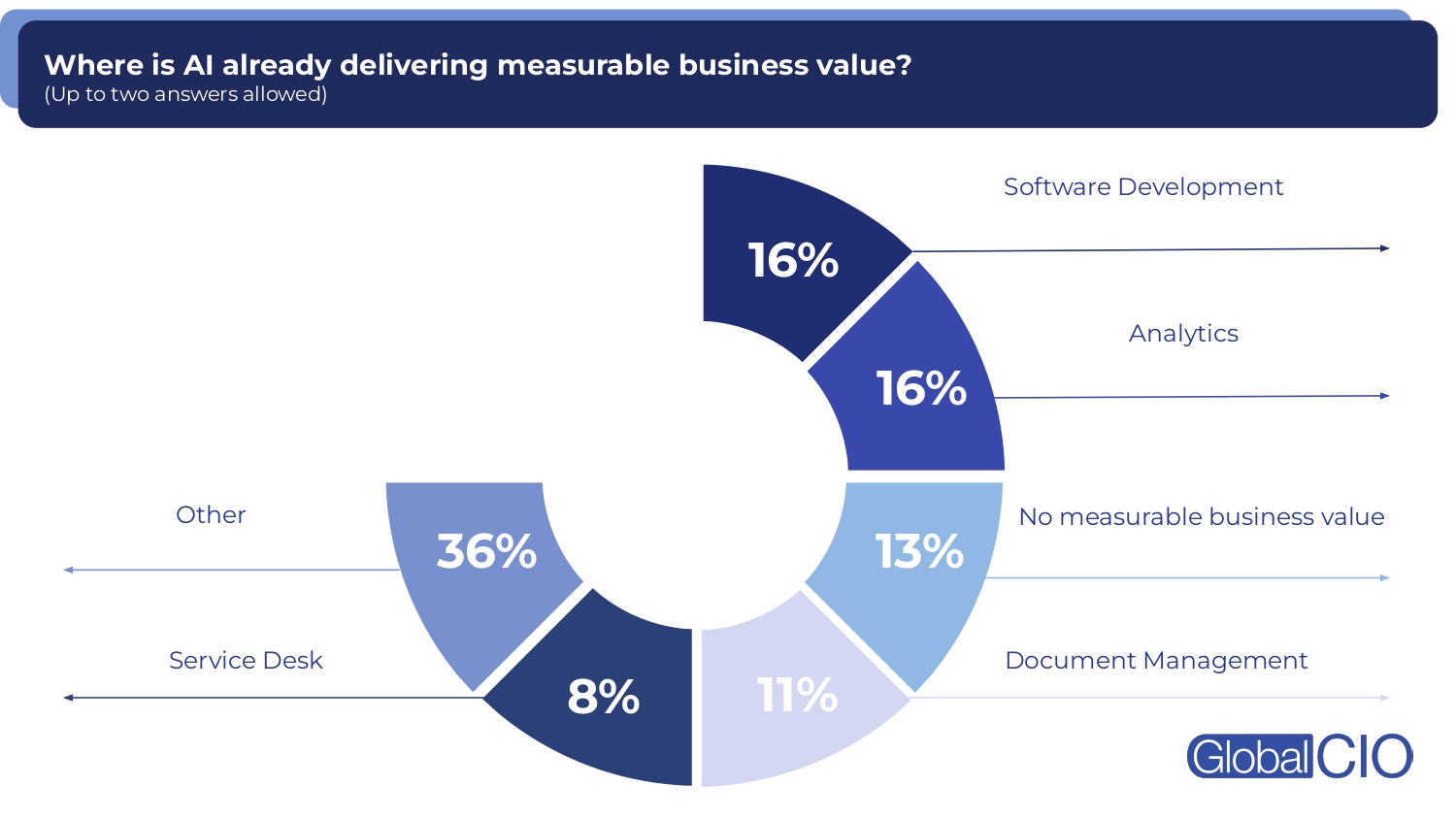
Artificial intelligence remains one of the main areas for future investment. If IT budgets increased by 30%, AI would be the top choice for additional spending among Global CIO survey respondents.
AI agents (20%) and AI in general (18%) also lead the list of technologies expected to have the greatest impact on business over the next two years.
However, there is still a significant gap between interest in AI and its practical use.
46% of respondents are running AI pilot projects, while 25% are still exploring the technology. Only 13% are scaling successful solutions, and just 7% report widespread AI adoption.
The biggest barrier to scaling AI is unclear ROI (20% of responses), followed by a shortage of skilled professionals (18%) and poor data quality (15%).
A similar picture appears in McKinsey's international study, The State of AI in 2026. Although 44% of organizations using AI are already scaling it across their businesses, only 37% of respondents report a positive impact on operating profit.
This shows that even widespread AI adoption does not automatically lead to financial results.
For CIOs, the next step is to move from isolated experiments to a more systematic approach. Instead of running dozens of separate pilots, companies should focus on a few areas where AI can make a real difference to business processes.
These might include customer support automation, software development, document processing, analytics, or repetitive tasks.
AI agents deserve special attention. They can not only answer questions but also complete a series of tasks. However, their use requires quality control, security measures, and clear responsibilities.
Every AI project should have measurable targets: how much employee time it saves, how much it reduces costs, and how it improves the speed and quality of work.
It is equally important to stop pilots that are not delivering the expected results.
The priority for CIOs is not the number of AI projects launched, but the number of solutions that work successfully and create real business value.
3. Modern Architecture and Quality Data as a Foundation for Growth
New technologies are difficult to implement effectively when existing systems do not work well together, data is spread across different platforms, and every change requires significant effort.
One of the most interesting questions in the Global CIO study was: What would IT leaders do differently if they could build their IT strategy again?
19% of responses pointed to modernizing IT architecture earlier, 17% to automating processes faster, 16% to developing internal skills, and 12% to investing more in data.
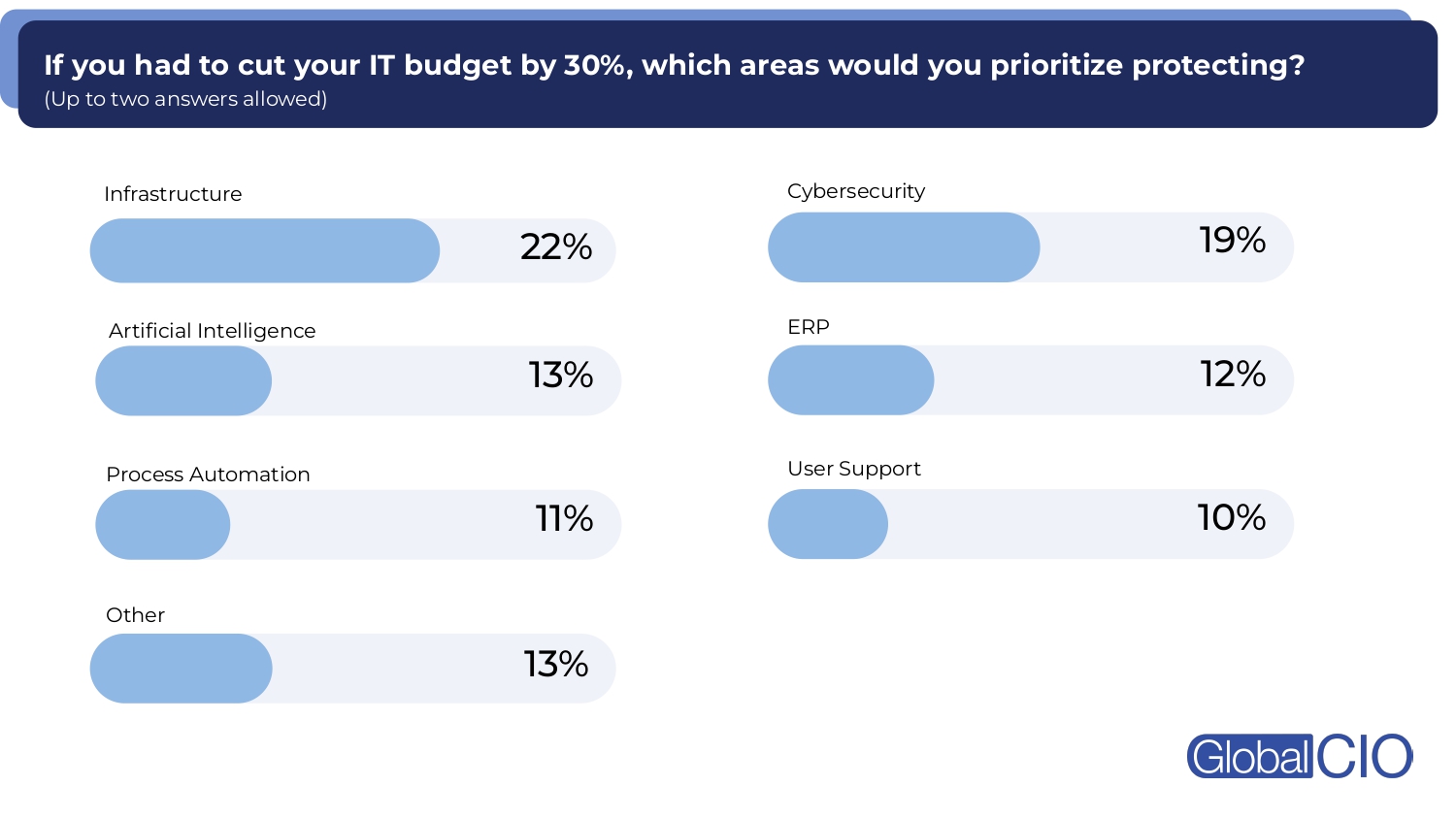
These results show the importance of decisions whose benefits may not be immediately visible.
Old IT architecture can support a company's operations for years. But over time, it may begin to slow down change. Launching new products takes longer, integrations become more difficult, and maintaining systems requires more resources.
AI makes these problems even more visible. Intelligent solutions depend on access to reliable, high-quality data. If information is stored in separate systems, contains errors, or quickly becomes outdated, AI's potential will remain limited.
That is why architecture modernization and data management should be seen not simply as technical projects, but as investments in the company's future capabilities.
Modernization does not always mean replacing existing systems completely. A gradual approach is often more practical: removing the biggest limitations, improving integrations, and creating common rules for managing data.
CIOs need to understand which parts of their IT infrastructure are holding the business back and focus their resources on improving them first.
The main goal is to build a technology foundation that helps the business make changes faster today and take advantage of new opportunities tomorrow.
4. Cyber Resilience and Reliability Remain Essential Priorities
With so much attention on AI, it is easy to forget that every business still depends on stable and secure IT infrastructure.
The Global CIO study shows that companies would protect these areas even if they faced major budget cuts.
When asked which investments they would keep if their IT budget were reduced by 30%, infrastructure received 22% of responses and cybersecurity 19%. AI followed with 13%, and ERP systems with 12%.
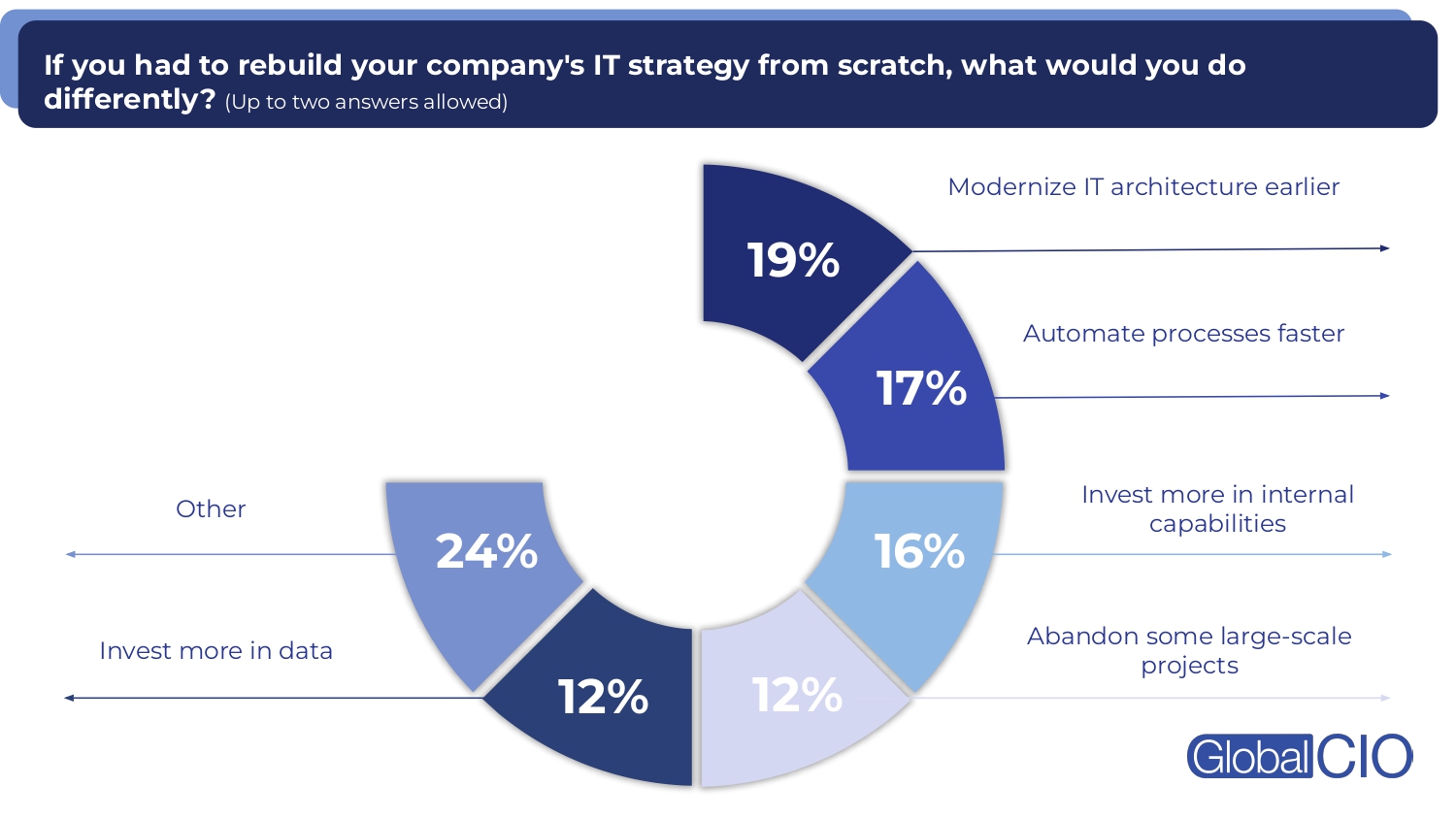
This reflects an important part of the CIO's role: a company can delay adopting a new technology, but it cannot afford a long outage of its critical systems.
At the same time, cyber risks are becoming more complex. Cloud services, digital partnerships, remote work, and AI all create new potential vulnerabilities.
According to the World Economic Forum's Global Cybersecurity Outlook 2026, 87% of respondents identified AI-related vulnerabilities as the fastest-growing cyber risk.
CIOs therefore need to look beyond traditional protection against cyberattacks. Cyber resilience — the ability to keep the business running during incidents and recover quickly afterward — is becoming increasingly important.
This requires more than investment in security tools. Companies also need regular backup testing, recovery plans, supplier risk assessments, and employee training.
It is especially important to connect these measures to real business consequences. For example, how much would one hour of downtime cost the company? How quickly would sales, production, or customer services need to recover?
These questions help business leaders understand why cybersecurity investments matter.
Reliability and cyber resilience are not alternatives to innovation. They are essential for making innovation possible.
5. The CIO as a Business Leader and Change Manager
Technology is becoming more complex, but the CIO's role is changing too.
In the Global CIO study, 56% of respondents said their role had become more strategic over the past three years. At the same time, 33% felt that their role had remained largely unchanged.
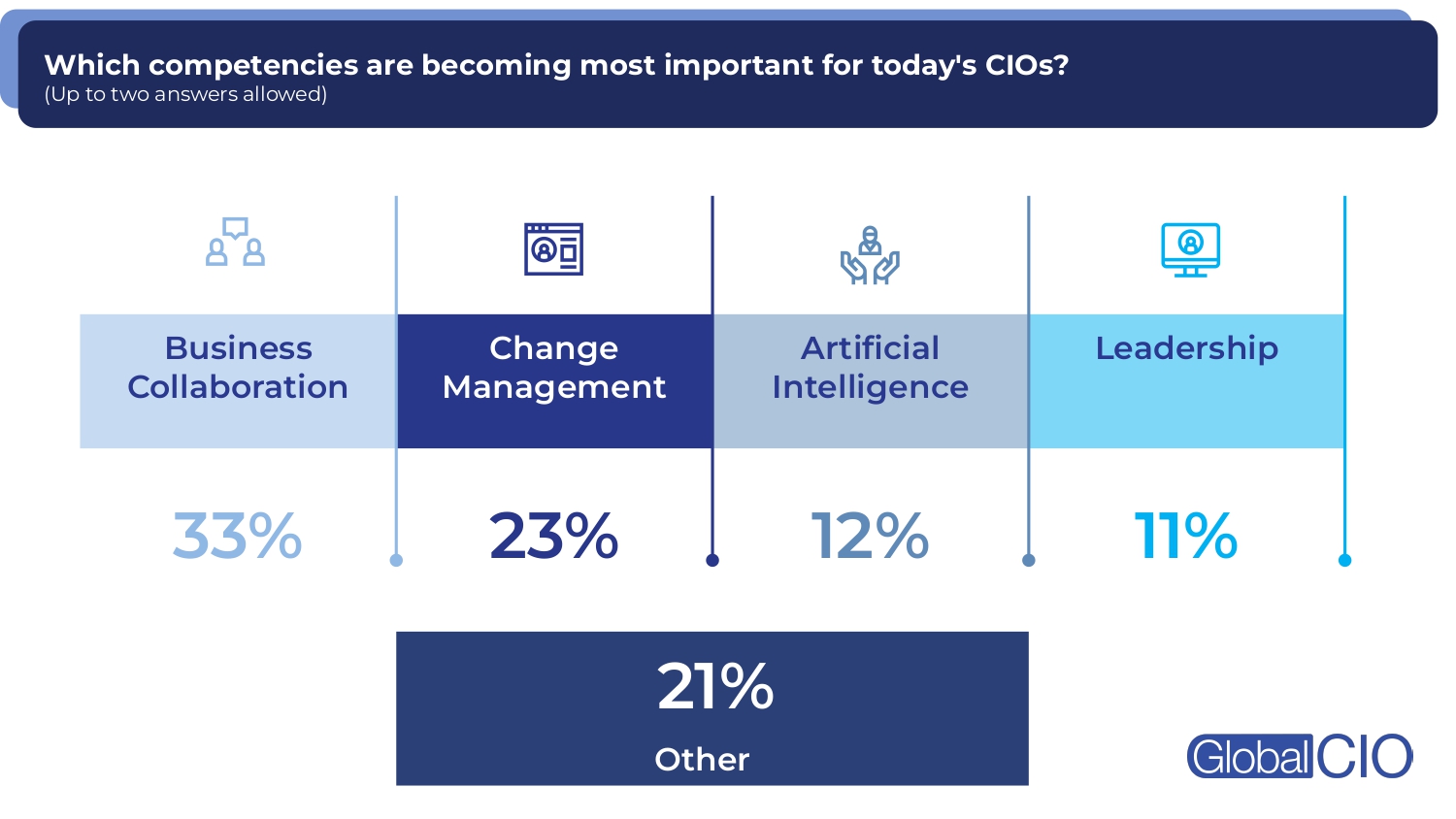
The skills that respondents consider most important for today's CIOs are also revealing. Working with business leaders came first (33%), followed by change management (23%). AI expertise received 12%.
This does not mean technical knowledge is becoming less important. But technical expertise alone is no longer enough to lead IT successfully.
CIOs need to understand business goals, work closely with department heads, set priorities, and explain how technology projects will affect business performance.
This trend is also supported by Deloitte's international 2026 Global Technology Leadership Study, which surveyed more than 660 technology leaders. 79% named achieving business results as their top priority. At the same time, 75% believe that organizations need significant changes to their operating models to get more value from technology.
Change management is becoming especially important. Even a good technology solution may fail to deliver results if employees continue working in the old way, department heads do not support the project, or teams lack the necessary skills.
That is why CIOs increasingly need to focus not only on implementing systems, but also on improving workflows, developing employees, and encouraging cooperation between departments.
Finding the right people also remains a major challenge. In the Global CIO study, the biggest skills shortages were reported in AI and cybersecurity.
One way to address this is to develop internal teams through training, knowledge sharing, and projects that bring together specialists from different departments.
The successful CIO of the future is not just a technology expert, but a leader who can bring people together and turn technology opportunities into real business change.
Conclusion: Fewer Technology Projects, More Business Results
The Global CIO study shows that IT leaders face a difficult balancing act. On one hand, they must control costs, keep systems running reliably, and prove the financial value of IT investments. On the other, they need to develop AI, modernize architecture, and help businesses adapt to change faster.
These goals do not conflict with each other. In fact, they should all be part of one IT strategy.
The five priorities for 2027 — measurable business value, AI at scale, modern architecture and data, cyber resilience, and leadership — are closely connected.
Without reliable architecture, scaling AI is difficult. Without skilled teams, managing change becomes harder. And without clear business results, future technology investments are difficult to justify.
Ultimately, a CIO's success will depend less on how many technologies the company adopts and more on how those technologies make the business more efficient, resilient, and competitive.