

What AI Transformation Actually Means for the CIO and Organization
14 August 2026
Pavel Poteev, Associated partner at O2Consulting and head of its digital and AI transformation practice, argues that the AI wave reshapes work, coordination, and power inside the enterprise, creating resistance at a scale CIOs rarely face in conventional IT programs. He maps what readiness requires and where IT and HR fit.
For most companies, "we use AI" and "we are AI-transformed" are different claims. Cutting a process from ten days to six is improvement, not transformation. Why is the AI wave different, and why may it trigger stronger resistance than earlier waves? Pavel has led enterprise transformations for over 25 years, from ERP in 1995 to AI transformation consulting today. He explains what changes with AI, why resistance runs three levels deep, and how CIOs can position IT alongside HR and business leadership.
Three Waves of Transformation, and Why This One Differs
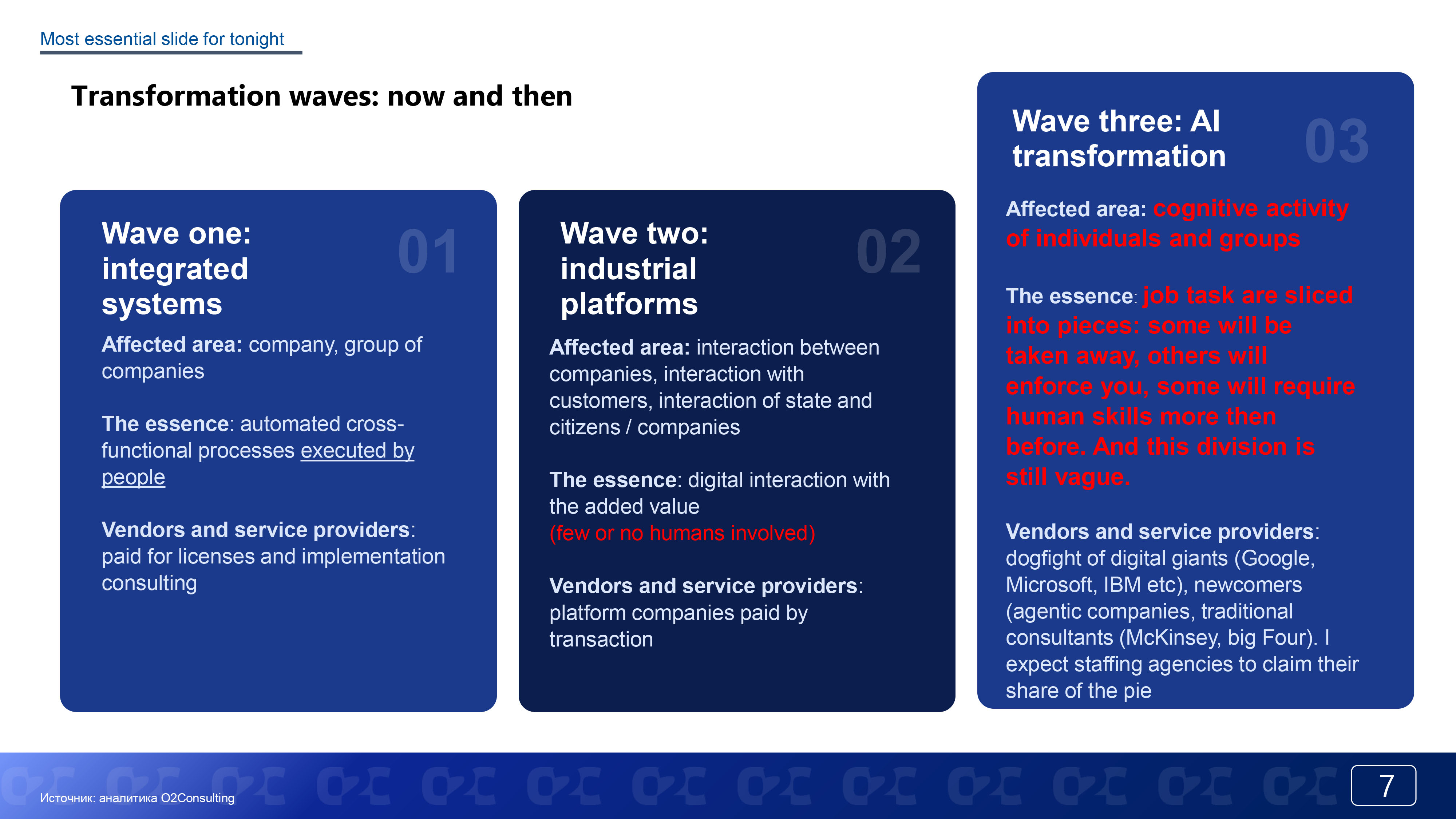
Enterprise transformation has moved through three waves. Integrated systems automated cross-functional processes on a per-license basis, rolled out top-down. Industrial platforms digitized interaction between companies, customers, and the state, and shifted payment to per-transaction.
AI transformation breaks both patterns. Adoption starts bottom-up, at individual workstations, before management organizes anything centrally. Instead of automating a whole process, it slices the cognitive activity inside individual jobs: some tasks are taken over entirely, others get faster with AI's help, and some demand more human skill, such as empathy and critical thinking.
Faster individual work does not automatically make a company more efficient. If an employee finishes an 8-hour task in ninety minutes but is still paid for eight, capturing that gain takes years of internal adjustment.
Dorsey's Vision: The Company as a Mini-AGI
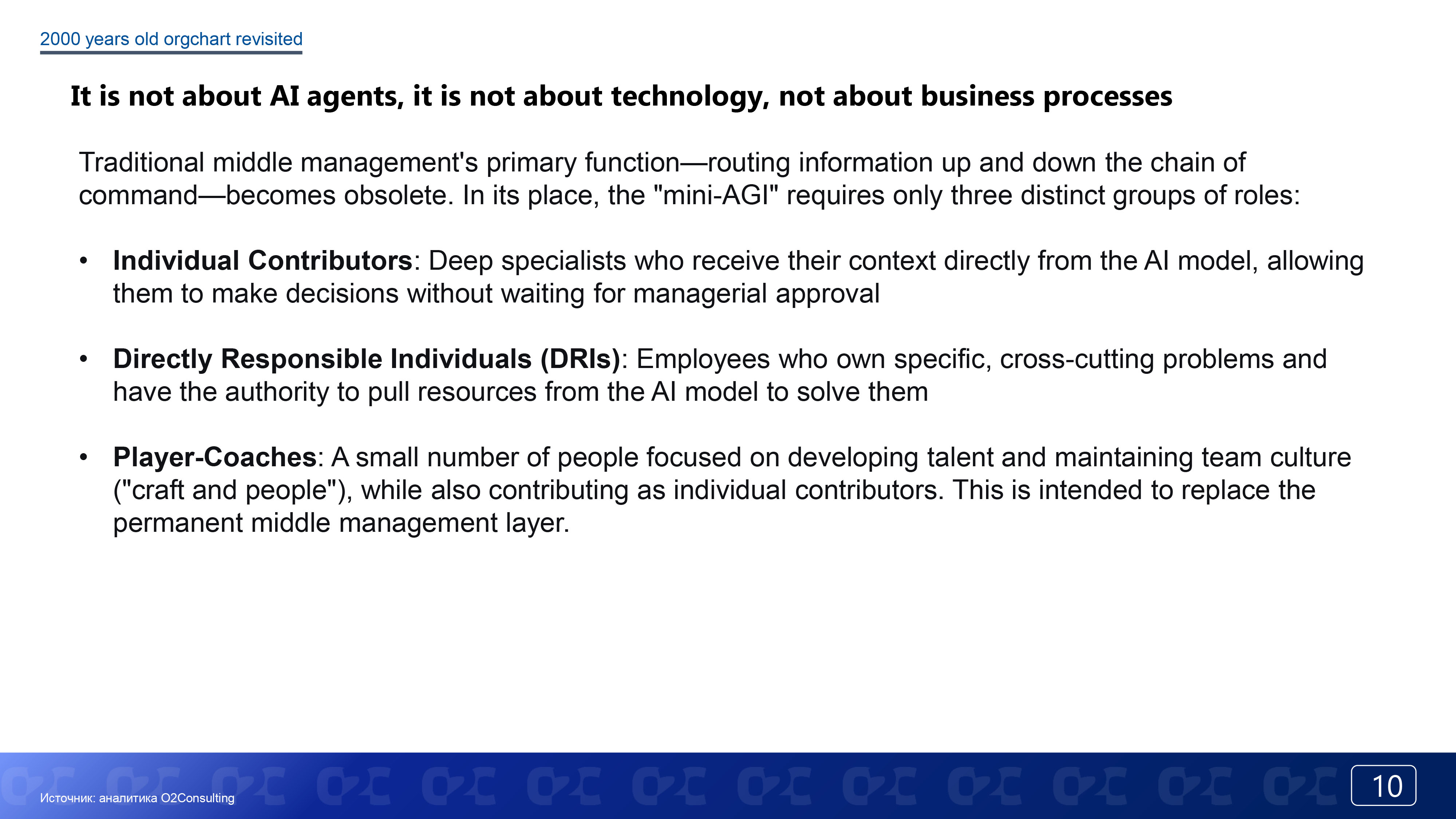
In April 2026, Jack Dorsey published a text-only vision of the AI-native company. Instead of a pyramid of managers coordinating six to eight people each, he proposes a company operating as a "mini-AGI", with AI taking over much of the coordination layer.
He describes three human role groups: individual contributors, directly responsible individuals who own cross-cutting problems, and player-coaches who preserve craft and culture. Their purpose is to replace much of the permanent coordination layer of traditional middle management.
Pavel notes that Dorsey's fintech company once had about 10,000 employees and has since cut roughly 4,000 roles, illustrating the social stakes around this kind of redesign.
Data Is the New King
An AI-native organization needs data well beyond what ERP ever required. Dell, with decades of SAP experience and mature data, still says it had to start by cleaning up its data. IBM frames the requirement as a four-step ladder: collect data regardless of source, organize it into a governed foundation, analyze it with reproducible models, and infuse it into business applications. Agents on decentralized data simply hallucinate.