When Fighting Fires Isn't Enough: Moving from Tactical to Strategic IT Leadership
9 November 2026
At the fictional company Horizon, development of its digital platform, Horizon X, has stalled. The IT team is tied up maintaining legacy systems, integrations keep failing, and employees are unhappy about the rollout of AI. Meanwhile, the board wants a strategic decision. Where should the company invest, what needs to change, and what should it stop doing?
Participants tackled this challenge during the master class “Leadership Mindset: How to Think Two Moves Ahead and Succeed in Uncertainty” at Global CIO Academy. Acting as a management team, they were asked to propose a strategy for Horizon X to the board. The session was led by Evgeny Pitolin, a practicing consultant and business trainer, and former Managing Director of Kaspersky Lab for Central Asia, the CIS, and the Baltic states.
Participants worked through the case, tested their arguments, and compared possible decisions with their peers' experience. This article brings together several strategic thinking tools and excerpts from those discussions. The live format also gave participants the opportunity to receive feedback from the expert.
Four Problems. What Comes First?
Before the first exercise, Evgeny drew a distinction between tactics and strategy. Restoring a system addresses an immediate problem; a strategic choice changes what the company will be capable of in the future.
Participants had to prioritize four problems:
- An integration gateway used to exchange data with partner systems had failed.
- Horizon X's operational metrics, including response times and data loading, had deteriorated by 15%.
- HR had received employee complaints about the AI rollout.
- The board expected budget proposals and a funding decision.
What should be addressed immediately, what could be delegated, and what could be left alone for now? Could these problems even be placed in a single priority order?
One participant suggested restoring the integration first, then responding to the board. Another pointed out that a CIO can delegate work to specialist teams and ask them for the information needed to make decisions. Someone also proposed a hypothesis that the problems might share a funding-related cause.
Additional context changed the picture. The gateway had failed three times in a month, while the platform's performance had been deteriorating for six weeks. Employees had learned about the planned AI rollout only from an internal newsletter, which may have influenced their reaction. The strategy presentation to the board had already been postponed twice. Systemic issues could be hiding behind the urgent tasks.
Evgeny turned to Daniel Kahneman's distinction between fast and slow thinking. A bat and a ball cost $1.10 together, and the bat costs $1 more than the ball. How much does the ball cost? The intuitive answer, 10 cents, is wrong. The correct answer is 5 cents: the bat costs $1.05. The example showed why an initial response deserves analytical scrutiny, particularly when management decisions feel urgent.
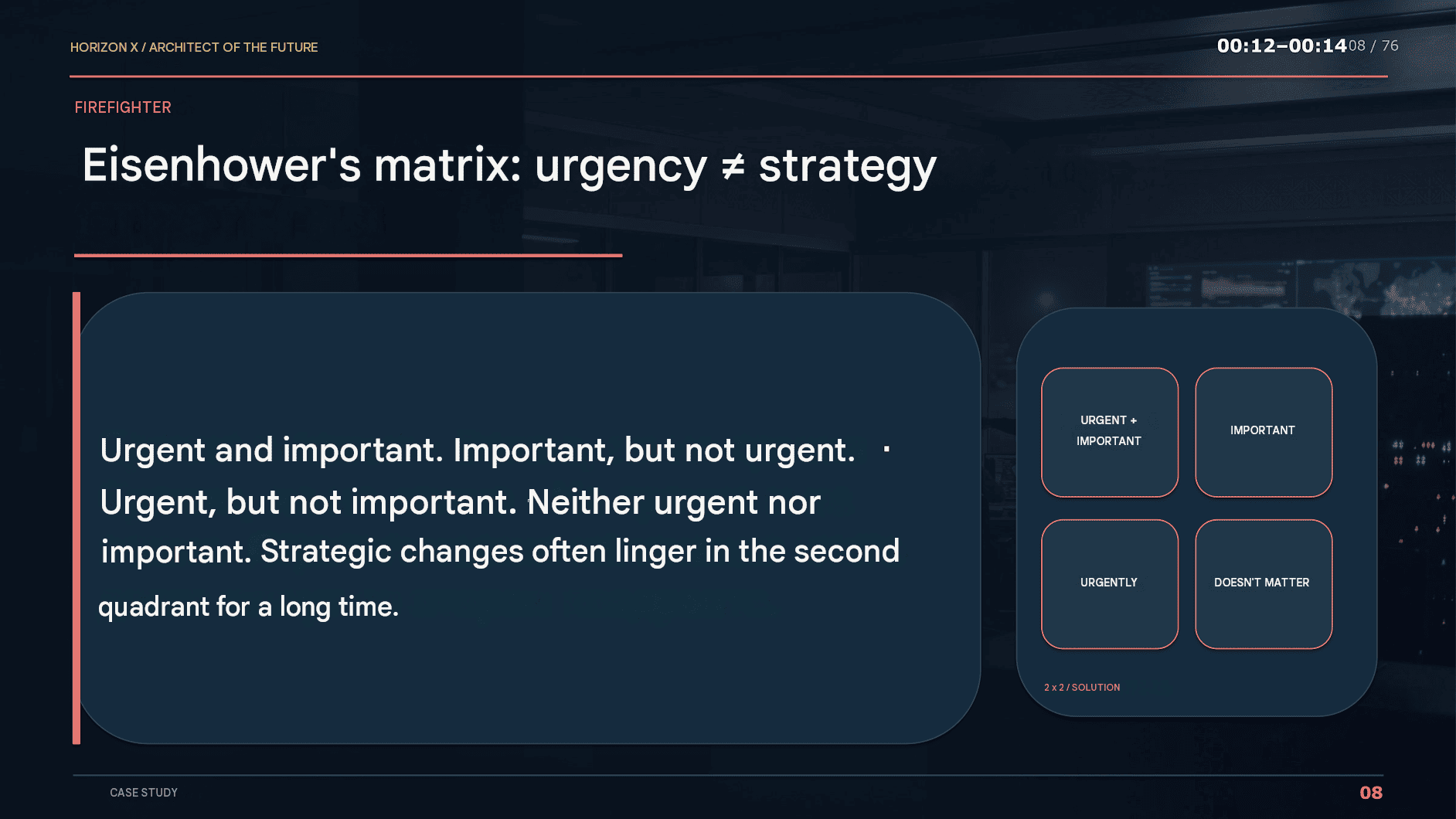
The Eisenhower Matrix offers another way to separate the urgent from the important. Incidents require immediate attention, yet systemic improvements that do not feel urgent can be postponed for months.
“The urgent always shouts louder than the important. But if we're constantly caught in that internal struggle, we risk never getting out of reactive mode.”