

Join the Project of the Year competition
On September 7, the international IT community, Global CIO, officially opened applications for the annual “Project of the Year” contest, where IT leaders from around the globe showcase their best IT projects.
The “Project of the Year” provides a valuable platform for IT leaders to showcase their achievements, share experiences, and gain recognition from their peers. Participation is free, with the primary goal being to identify, consolidate, and promote best practices within the global IT community.






Cases of the community members
View all cases
Project Samruddhi


Employee Digital Portal (EDP)


Industry 4.0 is no longer just a fashionable term for Kazakhstan. The country is confidently moving towards digital transformation, turning pilot projects into large-scale programs. Roman Yashin, Director of Softline Group in Central Asia, talks about key trends, barriers and market opportunities.

According to a recent survey conducted by the international IT community Global CIO, more than 40% of IT leaders look to professional associations not only for networking, but also for opportunities to learn. The Global CIO editorial team spoke with Barbara Dossetter, a leading practitioner at CXO Connect, a leadership development firm from London. In this interview, Barb delves into the evolving role of the CIO, the critical skills gap in communication and strategic presence, and how targeted executive education is shaping the next generation of IT leaders.

The hotel business in Uzbekistan is growing and digitizing: the hotel management system, ticket offices, online sales channels, mobile keys, smart devices in rooms, active social networks. Along with this, the risks are also growing. We talked to Ilkhom Begmatov, a regional representative of the Softline Group of companies in Uzbekistan, about how to build protection without losing speed and convenience for guestsSoftline.
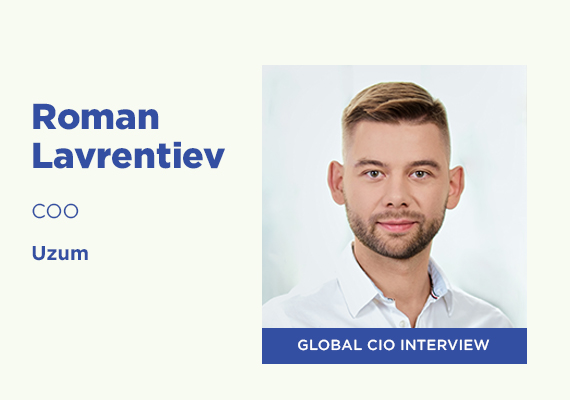
The Uzum digital ecosystem became the first technology "unicorn" in Uzbekistan in 2024 and continues to grow. The GlobalCIO editorial team spoke with Roman Lavrentiev, COO of Uzum. An IT leader with a product background, he has built companies whose solutions operated from North America to Africa. Today, his experience in scaling global IT products is helping to build a key digital ecosystem in Uzbekistan.

Industry research shows that the growth rate of the information security market in emerging markets remains below projected values, averaging 20-25% per year. Experts cite the lack of local solutions as one of the reasons, which complicates budgeting and the implementation of new systems.


Alexander Kuliev, an expert in data-driven transformation, talks about the successful implementation of a digital management system in the Burger King chain with more than 800 restaurants. In three years, the company moved from expert solutions to a full-fledged data-driven model, achieving efficiency growth of up to 9% in certain segments. The author shares the key stages of transformation and the main lesson.

In a context of rising costs and stringent regulatory requirements, effective management of IT economics is becoming a key success factor for any modern organization. But how can this be achieved if even mature companies struggle to achieve cost effectiveness in their IT spending? Is IT truly a "black box" from which predictable and manageable results are difficult to extract? The answer to this question can transform a business's approach to IT management and increase profitability.

Traiano Leme presents the strategy "centralize the core, localize the periphery" for 160 international markets. The expert with 30 years of experience proposes a product-oriented IT model with global standards and local adaptations, including shadow IT management and IT department transformation.

Data backup is often perceived as something abstract or simply as another task pushed by an overzealous IT department. Managers frequently dismiss it with a wave of the hand: “What are those tech guys up to now?” In the hustle of daily operations, the pursuit of profit and solving immediate issues, this critically important topic often gets pushed to the sidelines. But take it from years of hard-earned experience: backup is not a whim. It is a fundamental matter of business survival. No exaggeration.

Low-code is not news or a trend, today every second (if not the first) platform provides opportunities for low-code customization. Why this is not always for the good, we understand in the article.

The Global CIO editorial team continues its series of articles on the conditions in which the IT business operates in different countries. We spoke with our partners about the development of the IT sector in their countries, specific challenges and opportunities they face, as well as the key success factors in each market. Today, we present one of the fastest-growing economies in Central Asia – The Republic of Uzbekistan.

In recent years, digital twins have become an integral part of the development strategy of leading industrial enterprises. This technology is transforming the approach to production management, asset maintenance and security.

Key insights from a panel of HR and engineering leaders working across Sub-Saharan markets. With 700,000 developers and growing startup ecosystems in countries like Nigeria, South Africa, Kenya, Egypt, and Morocco, Africa is becoming a strategic region for global IT hiring. Tech giants such as AWS, Google, and Microsoft are opening development centers, while remote opportunities continue to drive cross-border employment.

In a fast-changing tech landscape, creativity is no longer a “nice to have” — it’s what keeps IT teams functional across borders, time zones, and pressure. At a recent session hosted by Global CIO and moderated by executive coach Ekaterina Belyatinskaya, tech leaders from different industries came together to explore what creative leadership really looks like in action — and why it matters now more than ever.
Now many companies have reached the stage of implementing AI assistants, but not everyone has an understanding of where exactly to start and how to build a useful corporate service based on the new fashionable technology.

VIVEST's CIO Mr. Alex Galho led a 12-month AI transformation deploying Microsoft Copilot across 28 initiatives with documented ROI of 30% in health processing. The case study reveals that successful enterprise AI adoption requires structured people enablement and cultural change, not just technology implementation. Key lessons include moving from mass training to 1-on-1 mentoring and treating AI as continuous transformation rather than a finite project.